Sexuality in Medieval Europe: Doing Unto Others [2nd Edition] (2012)
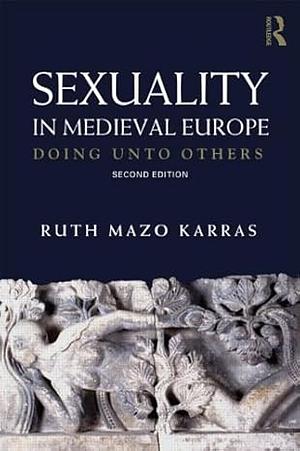
Author: Ruth Mazo Karras
Format: Paperback
Doing Unto Others is a survey on sexuality in medieval Europe that seems to be one of the best accessible modern compilations on the subject. Karras examines medieval Europeans’ (ranging across an extremely wide time / space, and including Jewish / Muslim perspectives along with the hegemonic Christian perspective) interactions with sex through a series of gendered case studies depending on whether people were married (e.g. sex in marriage, women’s sexuality outside of marriage, etc.). Karras argues, following scholarly consensus, that medieval conceptions of sex saw it as a transitive action; i.e., that sex was something that someone (usually men / the ‘penetrator’/’active’ partner) did to someone else (usually women / the ‘penetrated’/’passive’ partner). This transitive and gendered notion of sex and sexuality, though obviously extraordinarily misogynistic, provides an underlying framework for how different sexual encounters would be processed by medieval society. However, despite the clear emphasis on a social construction of sex and sexuality (and to a lesser extent, gender), Karras argues that the concept of sexuality as an identity is still, at its core, a useful concept to discuss in the context of medieval Europe. That said, the exact categorization of sexualities seemed to differ from modern sensibilities — this is most notable with modern-day queer sexualities, which are typically defined in terms of homo-(as opposed to hetero-)sexuality. Of note, Karras points out that (somewhat inherited from Classical norms) men who had sex with other men as the active partner, would generally not be considered to be particularly queer in the sense that this made up a crucial part of their identity. That said, of course heterosexuality was by far still the norm for people across medieval Europe.
While short (only ~200 pages), Doing Unto Others provides an extremely accessible resource for anyone trying get a better understanding of sex in medieval society. For a more in-depth overview, Karras provides a long list of further readings along with each chapter, which allow the text itself to keep a much broader perspective temporally and spatially. Because the edition I read was the 2nd edition (from 2012), I wonder if more modern editions (seemingly one was released in 2023) contain any more explicit discussion of queerness, especially with regards to gender — there are hints in the 2012 edition, but for the most part gender is glossed over. Mostly unrelatedly, I kinda wonder if any modern transfeminists have attempted any sort of large-scale analysis of medieval sexuality (I’m sure some exists somewhere but).