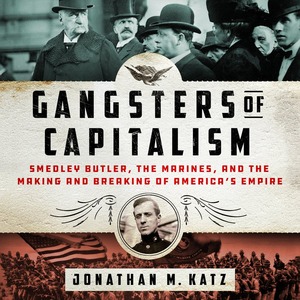
Gangsters of Capitalism: Smedley Butler, the Marines, and the Making and Breaking of America's Empire (2022)
Author: Jonathan M. Katz
Format: Audiobook (Narrator: Adam Barr)
Gangsters of Capitalism is a history of the life of Smedley Butler — a US Marine who fought in an alarmingly high number of US overseas imperialist wars, only to later become a pacifist and denounce the nebulous fascist Business Plot — that takes his life as a framing device to explore the construction of the US’s overseas empire and its lasting legacy in the modern day. The book bounces between a narrative of Butler’s overseas campaigns (in the Philippines, Haiti, China, etc.) with a narrative of Katz traveling to the same places and conducting interviews with many of the local residents whose lives have been indelibly shaped by American imperalism.
The book is not particularly complicated or dense — due to the split nature of the narrative and large amounts of space dedicated to basic historical context for all of the countries involved, each individual narrative thread only gets a cursory amount of focus in the text itself. The conclusions consequently feel rather anodyne; who could’ve guessed that US imperialism is often overlooked in favour of its role in the two World Wars or that business interests dictated (and still dictate !! wow) US foreign policy. That said, it still serves as a nicely written and straightforward narrative of US imperialism in the early 20th century (incl. the Spanish-American war, interventions throughout Central America / the Caribbean in Nicaragua, Panama, Mexico, Haiti, the DR, interventions in China and the Philippines) that beats the Frantz Fanon / Aime Cesaire imperial boomerang analysis — that fascism is simply overseas imperialism coming home to roost in the imperial core — into your head.
The modern-day narrative was by far the most variable portion of the book for me. Katz manages to draw interesting testimonials and occasionally some insightful commentary on the modern state of colonized countries from his trips, but every single moment is necessarily tinged with a both-too-self-aware and not-self-aware enough white American™ lens that inevitably causes awkward moments in his discussions with current residents of the colonized countries. The connections to contemporary geopolitics occasionally feel a bit overwrought as well, or constructed in a manner that would’ve benefited from a much more nuanced / deeper exploration (which, ofc, probably wouldn’t be practical but still).