Interference (2019)
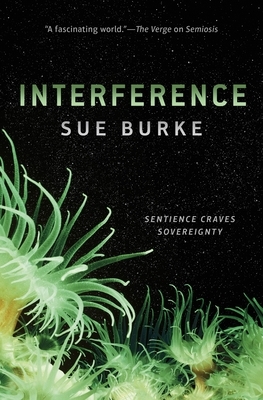
Author: Sue Burke
Format: Paperback (ty Robin)
Interference is the second book in a trilogy (after Semiosis) about a small group of Earth colonists who arrive on a very Earth-like planet called Pax. (Spoilers for both from here.) The first book focuses on this group as they try and slowly build a society for themselves over many generations; they eventually succeed in establishing something more permanent with the help of Stevland, a huge intelligent bamboo-like plant that dominates their continent, and Glassmakers, a very ant-like species of intelligent aliens that happened to also be present on the planet.
In Interference, a new group of scientists / etc is set from Earth to check out how the colony is doing / report back to Earth, which itself seems to be going through a large amount of political turmoil under a repressive surveillance society. The book focuses on the Pacifists’ and Earthlings’ conflicts between themselves and with each other, as well as a threat from a similarly-intelligent seeming species of coral out in the plains.
I thought Interference was overall weaker than Semiosis; while there are fun and interesting interactions between the Earthlings and Pacifists (especially around their confusion with Stevland, who they alternatively believe is some sort of god or secret member of the village), there is much less of a substantial plot - the main “action” of the book is introduced and then dealt with within the span of like, 20 pages at most. This would be fine as more of a character study, except that basically every character except maybe Stevland is deeply annoying. Karola, a member of the Earthling expedition who forces her way onto the expedition to escape what she discovered was her fate as Earth’s eternal scapegoat (think Omelas kid, but like, propagandized), is by far the most sympathetic and compelling human character, but she gets the prologue and no other focus throughout the rest of the book, except as a plot device.
This all helps to drive home the overarching point that Stevland, over the generations, has functionally domesticated the Pacifists and Glassmakers. In of itself, this is a fine way to take the story and is has a lot of potential, but it’s not really resolved at all thematically (I guess there’s a third book in the series, which might help). In practice, it feels like Stevland is, in fact, almost divine in his supernatural intelligence and mostly deus ex machina’s his way into making the village survive once he’s given enough access to the environment.
The prose is also noticeably average / simplistic, which I thought could be maybe a product of Stevland’s “domestication” etc., but I think is just Burke’s style.