Monk & Robot (2022)
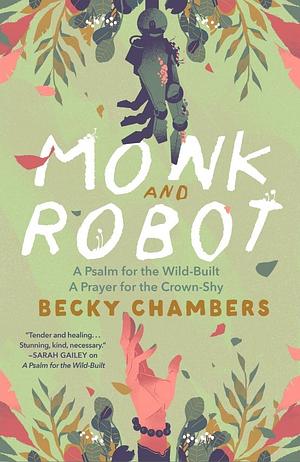
Author: Becky Chambers
Format: Paperback
Monk and Robot is a sci-fi novel1 about a post-industrial world called Panga. At some point centuries before the novel is set, humanity’s robots obtained sentience and collectively decided to walk out of human society, shocking human society into completely restructuring into a sustainable, eco-friendly, utopian2 society. The novel follows Dex, a former solitary monk of the god Allalae who upturned their life to become a tea monk. In their role as a tea monk, they travel between the different communities of Panga and offer tea and counseling to others in the area. However, by the time the novel catches up with Dex, they have become yet again disillusioned with their work, and decide on a whim to leave to explore the dangerous uninhabited wilderness. Miles away from human society, Dex is suddenly approached by a robot known as Mosscap, who explains that it has been sent as an ambassador to humanity from the robots to ask “what do people need?”. The rest of the novel follows Dex and Mosscap as Dex brings Mosscap around to various human settlements to try and help Mosscap answer its question. Throughout their journeys, Mosscap and Dex discuss the nature of consciousness and humanity with each other and with the people they encounter.
I really enjoyed Monk and Robot; it’s not a particularly intense novel and, as such, is deeply calming in a way that was extremely welcoming. There’s little to no conflict per se in the story - at most, Dex and Mosscap have a brief encounter with a village that is bigoted against any form of technology (in what seems like an admittedly not-that-interesting parallel to real-world bigotries). In the absence of any true conflict, the novel is almost theraputic - Chambers is extremely good at painting a very pretty image of the utopian world that she’s constructed3.
I do think the novel is a bit hampered by its length - while the setting and premise of the novel probably couldn’t sustain an extensive series, I think each of the little vignettes in the novel could probably be heavily fleshed out without making it drag. In particular, the book raises a lot of questions about human nature, consciousness, etc., that are simply raised and never touched upon again. While these questions obviously aren’t meant to be answered in the novel itself, the questions themselves could stand to be elaborated upon with more interesting scenarios thrown at Dex and Mosscap. As it stands, the novel occasionally feels like a series of scattered throughts that never go anywhere in a manner that could be slightly frustrating (though I do think the setting more than makes up for this).
The world itself is a draw for the book: unironically the easiest way to describe it is simply “extremely woke”. Traditional money has been abolished and replaced with an obligation-based system, nonbinary gender identities are completely accepted and relatively commonplace, traditional family structures haven’t technically been completely abolished but are vastly different (one chapter opens with Dex trying to explain the exact nature of their parents’ polycule to Mosscap), and, as mentioned, society has been completely restructured to be completely sustainable and “in-tune” with nature as much as possible. Most notable, though, is the complete absence of any characters who could be said to be acting in anything resembling bad faith; while the world is clearly not free of disagreements, every character (that we see, at least) seems to be, for lack of a better word, a fundamentally good person. This atmosphere may not work in every, or even most, stories, but it works very well for Monk and Robot, which primarily tries to focus on exploring fundamental questions of human nature and desire. Honestly, the media I’ve consumed recently that reminds me the most of Monk and Robot is probably Frieren4 in its calmer aesthetic / relative lack of (real) conflict.
Overall, I’d definitely recommend Monk and Robot to basically anyone looking for a quick and fun read that hopefully makes you feel a little better about the world.
-
Technically, it compiles the two novellas A Psalm for the Wild-Built (2021) and A Prayer for the Crown-Shy (2022) into a single volume, though I think it works better as a single unit than the two would work separately. ↩
-
Wikipedia calls it solarpunk, which, like, is totally correct but I forgot the term existed ngl. ↩
-
Ok wdym Wikipedia she’s a “pioneer of the hopepunk genre” now people are just making up genres smh. ↩
-
Minus the fact every Frieren fan on the Internet is a Nazi 😭. ↩