Notes of a Crocodile (1994)
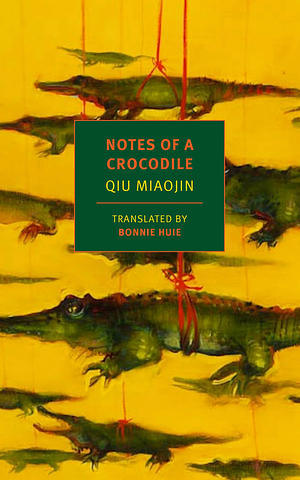
Author: Qiu Miaojin (trans. Bonnie Huie)
Format: Digital
Notes of a Crocodile is ~200 pages of a Taiwanese lesbian university student crashing out for her entire undergrad over a self-sabotaged situationship with her classmate, Shui Ling. Interspersed with notebook entries from the narrator about her extended crashout are snippets about the ‘discovery’ of ‘crocodiles’, who supposedly don human skins to blend into society, and the media phenomenon that this discovery creates. The novel does an excellent job of capturing the feelings of complete despair after disastrously fumbling a relationship and paints a very colourful portrait of someone who cannot seem to get her shit together and stop distancing herself from any sort of intimacy or vulnerability (or alternatively, become wayy too codependent) until it’s too late.
The novel also features a number of queer friends of the narrator who almost all feel comphetted to all hell and back - there is a frequent refrain of ‘moving on’ from women (or men, depending) and throwing oneself into heterosexual relationships as a form of ‘growing up’, always with an underlying sense of regret. The narrator, though she hints at cope flings with men, seems to be the only character who cannot seemingly give up her lesbianisms and gets punished for it by her continual crashouts. There is an interesting entanglement of gender and sexuality - the idea of giving up gay relationships is often framed as ‘embracing femininity’ (or masculinity) or ‘becoming a real woman’ - which feeds into the seeming desire for normality within society.
The crocodile interludes serve as pretty straight metaphors for homosexuality / queerness in general. A particular thread that resonated was the combination of treating crocodiles as media spectacles and objects of public debate while actively refusing to listen to crocodiles themselves speak to their own desires - the concept of ‘epistemic injustice’, which has been utilized by various trans writers in recent years, seems particularly relevant here.
Reading the novel itself was a bit of an odd experience, mostly in that I found it very easy to lose track of time in the story. It’s especially odd since every so often there’s an explicit date for a notebook entry, so maybe I just was reading too quickly or something. That said, it does seem a little bit deliberate that the exact timeline with how much the narrator and Shui Ling interact is rather tricky to precisely piece together both because the narrator is crashing out the entire time but it is in fact rather unclear how much the two actually are in contact with each other at all.