Women's Work: The First 20,000 Years: Women, Cloth, and Society in Early Times (1994)
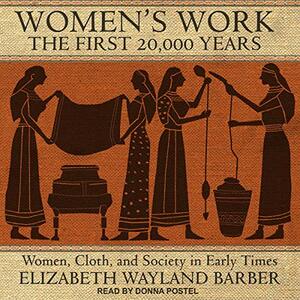
Author: Elizabeth Wayland Barber
Format: Audiobook (Narrator: Donna Postel)
Women’s Work: The First 20,000 Years examines the history of textile production and how it relates to the role of women in society, especially in prehistory and very early history (up to ~Late Bronze Age). Barber’s core argument is that textile production (and its associated chores—spinning thread, making clothes), as a necessary human activity for survival, was inevitably tied to women due to women’s role in childrearing. Thus, it is possible to reconstruct the lives of ancient women solely through examining artifacts of textile production (e.g. the dispersal of loom weights), even if their lives are not recorded in any typical source. Barber uses this framework to analyze the lives and movements of women in the ancient world, although inevitably most of the book is focused on the ancient Mediterranean, Mesopotamian, and European worlds. The book definitely reflects its era somewhat, but in a good way—many of the techniques Barber mentions now feel almost conventional, such as in her use of proto-Indo-European reconstructions (i.e. if a certain word can be reconstructed in PIE, it must have existed for people who spoke PIE).
By far the most novel technique that Barber advocates for is the role of the historian herself in reconstructing history; specifically, Barber advocates for historians to actually try their hands at recreating, for example, ancient textiles. Indeed, the entire first chapter of the book is focused on the basics of spinning and weaving—how would someone, physically, actually create a blanket from scratch? Throughout the book, Barber notes specific instances of confusion over textile artifacts that were easily resolved once she (or a colleague) actually sat down and made the textile themselves. I do wonder somewhat if this is a product of, again, weaving / textile work specifically being so tied to women and the dominance of men in the academy (and therefore very few academics prior to this work would have even considered this as an option); alternatively, I would like to find more discussion of the role of historical reconstruction in analyzing history (surely reenactment circles have thought about this a good amount…).