The World Turned Upside Down (1972) / The Cheese and the Worms (1976)
Authors: Christopher Hill / Carlo Ginzberg (Translators: John Tedeschi, Anne C Tedeschi)
Formats: Paperback / Audiobook (P.J. Ochlan)
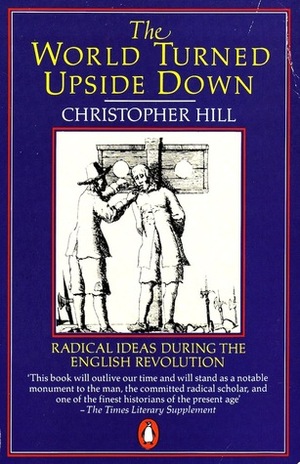
The World Turned Upside Down: Radical Ideas During the English Revolution is a detailed exposition of the radical religious and social ideologies floating around in England during the English Civil War (or English Revolution, etc.). Hill begins with a brief exposition of the social conditions in England during the 17th century - forest banditry, wandering merchants and preachers, etc. - which sets the stage for the second half of the book, which essentially involves Hill discussing a bunch of separate religious movements. In particular, his discussion of the Seekers, Ranters, and Quakers seems to serve implicitly as a method of tracing the development of Quakerism from its radical roots to something much more palatable to the state.
Unfortunately, the book as a whole assumes a lot of background knowledge, both about the course of the English Civil War, and about the intellectual movements themselves. The assumption that the reader is familiar with the English Civil War is explicitly noted by Hill in the introduction, but it feels like it somewhat defeats the point of the book to assume a decent amount of knowledge about what the different movements discussed in the book are. I would’ve appreciated more straightforward exposition of the basic tenets or characteristics of the intellectual movements, at least (though he does note occasionally that this is more or less impossible for, e.g., the Ranters). The lack of contextualization also makes it difficult to tell how important some each movement was. How much of an influence did the Diggers really have on English society? Hill especially focuses on Winstanley’s ideology as the leader of the Diggers; without additional context about the Diggers and their place in broader history, it’s hard to tell for what purpose - does he just like Winstanley (understandable)? Is he just trying to show that some people were super radical / ahead of their times?
In general, the book is fairly readable - the content of most of the chapters tends to be a bunch of quotes / examples pulled from a rotating cast of radical leaders, which makes the text itself rather dense, but also fairly skimmable without losing much information.
It was mildly interesting to be reading both The World Turned Upside Down and Carlo Ginzburg’s The Cheese and the Worms at the same time; The Cheese and the Worms explores the life of Menocchio, an Italian miller who lived in the Friuli during the 16th century who was tried twice by the Roman Inquisition heresy and eventually executed for his repeated expression of heretical beliefs. Most famously, Menocchio thought that the universe was made of a mass of the four elements (think a block of cheese) through which angels burrowed (like worms in the cheese get it) and, in particular, that God was simply one of the angels in the cheese. Ginzburg spends a large chunk of the text exploring the idiosyncratic ideas expressed by Menocchio in his Inquisition questionings, trying to tease out where Menocchio could have developed his heretical ‘teachings’.
Ginzburg especially highlights the widespread influence of oral culture, which could not be traced but certainly must have been impactful on Menocchio’s thought (at one point, he even conjectures that a widespread oral culture somehow transmitted Manichaean beliefs from central Asia, though he notes in the updated preface that this was pretty thoroughly debunked after publication), as well as the influence of widespread literacy (Menocchio’s collection of books, including famously Mandeville’s travels and possibly even the Quran, is discussed at length by Ginzburg). Through this analysis, Ginzburg underscores how influential the ‘mass culture’ could be, even in early modern Europe, despite the common modes of cultural analysis focusing on ‘top-down’ cultural diffusion.
Interestingly, the tenor of the heretical beliefs held by Menocchio often seem to have parallels in the writings of the English radicals running around during the English Civil War - there seems to be an emphasis on derivation-from-first-principles or theology that ‘makes sense’ to a layperson. In this sense, the heresies seem to be more ‘rationally’ derived; it’s hard not to imagine that much of this is directly due to the influence of the Reformation (though Menocchio himself claims to never have been in contact with Protestant preachers or anything of the sort). I would have more thoughts here but I took too long to write this and I’ve now forgotten 😌 but like, trust me it was pretty cool.